In the Harvest Fields of Christ: The Life Path and Pastoral Service of Archbishop Afanasiy (Martos)
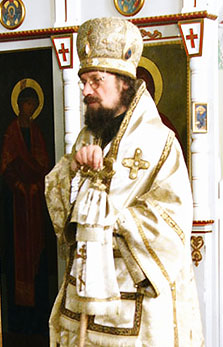 Archbishop Afanasiy (born Anton Vikentyevich Martos) was born on September 8 (21), 1904, into a peasant family in the village of Zavitaia near the town of Nesvizh in the Minsk Governorate. From a young age, he received a good education, finishing elementary school, the Nesvizh Higher School, and in 1925 — the gymnasium. His desire to dedicate his life to serving God led him to the Orthodox Theological Faculty of Warsaw University, where he studied from 1926 to 1930.
A special place in the life of the future archpastor was taken by his monastic tonsure. On January 4, 1927, at Holy Dormition Pochayiv Lavra, he was tonsured as a monk with the name Afanasiy, in honor of the venerable martyr Athanasius of Brest. On January 29, 1928, his ordination as a hierodeacon took place in Warsaw, and in March 1929 he was ordained as a hieromonk. This marked the beginning of his many years of pastoral service, which would go through difficult historical tribulations and extend to many countries around the world.
Originally, Father Afanasiy tended to the Orthodox Russian community in the settlement of Blagodatnoye near Warsaw, and then he was appointed abbot of SS Peter and Paul Church in the town of Wolomin. In December 1931, he became the hegumen of Yablochinsky Monastery, where he was also entrusted with caring for a shelter for elderly clergy. Later, he worked in Turkovichy in the Kholm region, setting up a monastery compound there, served in the churches of the cities of Kielce and Radom, and was also involved in the education and spiritual guidance of students at the Faculty of Theology of Warsaw University. In 1938, he was elevated to the rank of hegumen, and then archimandrite.
Alongside his pastoral work, Archimandrite Afanasiy was involved in theological and historical scholarship. In 1933, he earned a Master of Theology degree for his research on Saint Dimitry, Metropolitan of Rostov, as a pastor and teacher of pastors. In 1939, he was awarded a Doctor of Theology degree for a work dedicated to the Great Catechism of Metropolitan Peter (Mohyla). His academic interests were closely connected to the history of Orthodoxy and the spiritual heritage of the Russian Church.
The years of World War II became an especially serious period in his life. In March 1942, Archimandrite Afanasiy participated in the Council of Belarusian Bishops in Minsk, where issues of church organization and the restoration of Orthodox church life in Belarus were discussed. On March 8 of the same year, he was consecrated as Bishop of Vitebsk, with the temporary administration of the Novogrudok diocese. In Novogrudok, the bishop organized two-year pastoral courses to ensure the training of new clergy. During the military occupation, he opposed the interference of secular political forces in the internal life of the Church. He is also known for petitioning for the release of Metropolitan Panteleimon (Rozhnovsky) and the residents of Belarusian villages who were threatened with forced labor in Germany.
In June 1944, along with other Belarusian bishops, Bishop Afanasiy left the borders of Belarus. In 1946, he joined the Russian Orthodox Church Abroad, sharing the difficult fate of exile and dispersion across different countries of the world with the numerous Russian church émigrés. In September of the same year, he was appointed administrator of the North German Diocese, with his seat in Hamburg. One of the most important directions of his pastoral work became providing spiritual care for Russian refugees in displaced persons camps, who found themselves far from their homeland, familiar churches, and usual church routines.
In the early 1950s, the bishop was sent to serve in Australia, where he carried out pastoral work in the Melbourne and Brisbane vicariates. In March 1956, at his own request, he was transferred to the Argentine-Paraguayan diocese, which oversaw the Orthodox parishes of Argentina, Paraguay, and Uruguay. This appointment marked the beginning of a new, very significant period of his pastoral work, connected with ministering to the Russian Orthodox emigration in South America.
Upon arriving in Argentina, the bishop faced the need to further organize the church life of the large Russian community, a significant part of which consisted of émigrés who had arrived from Europe after World War II. For many of them, the Orthodox church was not just a place of prayer, but a spiritual connection to the homeland they had left behind, its history, language, and church traditions. At first, services were held in adapted and rented spaces that lacked the necessary conditions for full parish life. Therefore, one of the main tasks for the new shepherd was to create a proper cathedral that could bring the Russian Orthodox faithful together.
Bishop Afanasiys showed great persistence in the construction of the cathedral. He organized an initiative group, involved representatives of the Russian emigration in this endeavor, and suggested that every Orthodox Christian donate funds based on the cost of one square meter of the future church. This idea was met with enthusiastic support among the faithful. Not only wealthy benefactors but also ordinary parishioners, contributing what they could and offering their own labor, joined the construction. Among the Russian emigrants, there were architects, engineers, and construction specialists who provided significant help in carrying out the project. The bishop personally took part in organizing the construction work, and according to contemporaries, he did not shy away from even the heaviest physical labor, helping to carry building materials and wheel bricks and sand in a cart.
So, through the combined efforts of the clergy and laity in Buenos Aires, on Nuñez Street, the Resurrection Cathedral was built. By Easter 1958, the construction had reached a level of completion such that the first service was already held in the church. The solemn consecration of the cathedral took place in 1960. Later, a bishop's house with parish and service rooms was built at the church. The construction of this cathedral became the most important event in the life of the Russian Orthodox emigration in South America and the main visible fruit of the first years of Bishop Athanasius's pastoral service in Argentina.
Equally important were his efforts to strengthen the position of the diocese itself. The bishop cared about obtaining legal status and recognition from the state authorities for Orthodox communities, sought to organize parish life, and ensure the stable standing of church institutions. He also paid attention to preserving the existing Orthodox parishes and their church unity. A significant event was the return of the Holy Trinity Church in Buenos Aires to the jurisdiction of the Argentine Diocese of the Russian Orthodox Church Abroad in 1961.
Archbishop Afanasiy paid special attention to people who found themselves in need and had no relatives able to help them in difficult life situations. At his initiative, a diocesan funeral fund was established to provide financial assistance to poor Russian people for the burial of their relatives. This initiative had significant practical importance: according to the bishop himself, help from the fund was provided in more than a hundred cases of death. Aiming to strengthen the spiritual life of the younger generation, the archpastor organized a youth club, where participants gathered for social interaction and spiritual education. Later, some of them chose the path of church service and became clergy.
At the end of August 1957, taking into account his diligent service to the Holy Church and significant efforts in organizing the Argentine diocese, Bishop Afanasiy was elevated to the rank of archbishop. His work in South America wasn't limited to just Buenos Aires: under his pastoral care were communities and parishes across a wide area of Argentina, Paraguay, and Uruguay. In these countries, Russian Orthodox people needed spiritual guidance, regular services, and the preservation of church traditions. For the faithful scattered across a distant continent, the diocesan organization and the care of the ruling bishop were especially important.
In 1962, Archbishop Afanasiy was elected to the audit commission of the Synod of Bishops of the Russian Orthodox Church Outside of Russia. However, in September 1969, by a decision of the church leadership, he was transferred to the Australian and New Zealand diocese. Parting with the Argentine flock was not easy for many of his spiritual children. In 1971, after a brief time away from the Argentine diocese, the bishop returned to lead the diocese again, continuing his service in Buenos Aires.
The return of Archbishop Afanasiy was a continuation of his many years of care for the church community he had created and strengthened. He once again focused his efforts on liturgical life, pastoral guidance for the faithful, and supporting the parishes. By that time, the Resurrection Cathedral, established with his direct involvement, had already become one of the main spiritual centers of the Russian Orthodox emigration in South America. The bishop continued to conduct services and preach, taking care to preserve the Orthodox tradition among the next generations of Russian emigrants, for many of whom South America had become a second homeland.
In 1979, the bishop, together with his congregation, celebrated the fiftieth anniversary of his pastoral service. It was an important milestone in the life of the archpastor, who had decades of monastic, pastoral, and episcopal work behind him, having endured the trials of wartime and many years of service among Russian people scattered across different countries of the world.
Archbishop Afanasiy passed away on November 3, 1983, in Buenos Aires, at the age of seventy-nine. His earthly journey ended far from his native Belarusian land, to which he devoted much of his work, but the archbishop's church service was not limited to one region or country. He carried it among people scattered around the world, striving to preserve the Orthodox faith, liturgical tradition, and a living connection to the spiritual heritage of historical Russia. Archbishop Athanasius was buried at the brotherly cemetery of the Holy Trinity Monastery in Jordanville, in the United States of America.
A significant place in the legacy of the late archpastor is taken by his historical and theological writings, among which particular attention is deserved by the major work Belarussia in Historical, State, and Church Life, which has become a valuable study of the history of Orthodoxy on Belarussian soil.
The life of Archbishop Afanasiy became a testament to many years of service to the Church of Christ during a time of profound historical changes. Monastic calling, pastoral care, archpastoral labors, and scholarly activity were united in his life by a single goal: to preserve the Orthodox faith and church tradition for future generations.
Hieromonk Roman (Kiselev)
|